Tales From A Lazy Fat DBA

Its all about Databases, their performance, troubleshooting & much more …. ¯\_(ツ)_/¯

Archive for the ‘Uncategorized’ Category

A simple lovely Python script to get complete row locking details in Oracle database …

Posted by FatDBA on August 12, 2023

Hi Guys,

Recently I was working on one row locking contention where the a particular row was locked in exclusive mode caused all subsequent sessions trying to modify that row went in to waiting mode and were were waiting on ‘enq: TX row lock contention‘ wait event. This was a classic pessimistic row locking scenario which was happening due to application design problem.

The situation is not new for most of the DBAs, and they know what is causing the block, the relationship of parent and child blockers, the blocking and block SIDs, lock modes etc., but things are sometimes difficult for non-DBA users who don’t know where to go, what to call and what to check where there is locking in the database stopping their program to finish and they are scratching their head.

I have tried to write a Python script which connects with the Oracle Database using cx_Oracle module using connection details and start executing blocking specific SQL statements embedded inside the python code. I have even tried to add exception handling for the cases when there is any syntax errors or any grammar issues. Tried to add color coding too with result seperators to make the output easy to read. The embedd code makes it self-reliant and complete and makes it very easy to run on any system.

The code is pasted below and is also available on my GitHub website. Here is the link to download the source code —> https://github.com/fatdba/OtherScripts/blob/main/Python-Locking-Main.py

We only have to make sure that we have Python, PIP and Python Module cx_Oracle installed on the server/host.

[oracle@fatdba ~]$ python --version
Python 2.7.5
[root@fatdba ~]# pip install cx_Oracle==7.3
Collecting cx_Oracle==7.3
  Downloading https://files.pythonhosted.org/packages/71/2a/91eb1ccb37a249772a93620ee0539a3f902b187ddb82978d8519abe03899/cx_Oracle-7.3.0-cp27-cp27mu-manylinux1_x86_64.whl (728kB)
    100% |████████████████████████████████| 737kB 1.3MB/s
Installing collected packages: cx-Oracle
Successfully installed cx-Oracle-7.3.0
You are using pip version 8.1.2, however version 23.2.1 is available.
You should consider upgrading via the 'pip install --upgrade pip' command.
[root@fatdba ~]#
[root@fatdba ~]$ pip --version
pip 8.1.2 from /usr/lib/python2.7/site-packages (python 2.7)


Here is the code of the tool.
import cx_Oracle

# Database connection details
db_username = "system"
db_password = "xxxx"
db_host = "hostname-fqdn"
db_port = "1521"
db_service = "xxxx"

bold_start = "\033[1m"
color_green = "\033[32m"
reset_format = "\033[0m"

def print_colored(text, color_code):
    colored_text = "{}{}{}".format(color_code, text, reset_format)
    print(colored_text)

# Define the SQL statements
sql_statements = [
'''
SELECT rpad(instance_name, 17) current_instance, status, STARTUP_TIME, HOST_NAME, version, DATABASE_STATUS FROM v$instance
''',
"""
alter session set nls_date_format = 'DD-MON-YYYY HH24:MI:SS'
""",
"""
SELECT
    OUTPUT || CHR(10) || RPAD('-', LENGTH(OUTPUT) - LENGTH(REPLACE(OUTPUT, CHR(10), '')), '-') AS OUTPUT
FROM (
    SELECT
    'INST_ID -->  '||x.INST_ID || CHR(10) ||
    'Serial ID -->  '||x.sid || CHR(10) ||
    'Serial Num -->  '||x.serial# || CHR(10) ||
    'User Name -->  '||x.username || CHR(10) ||
    'Session Status -->  '||x.status || CHR(10) ||
    'Program -->  '||x.program || CHR(10) ||
    'Module -->  '||x.Module || CHR(10) ||
    'Action -->  '||x.action || CHR(10) ||
    'Machine -->  '||x.machine || CHR(10) ||
    'OS_USER -->  '||x.OSUSER || CHR(10) ||
    'Process -->  '||x.process || CHR(10) ||
    'State -->  '||x.State || CHR(10) ||
    'EVENT -->  '||x.event || CHR(10) ||
    'SECONDS_IN_WAIT -->  '||x.SECONDS_IN_WAIT || CHR(10) ||
    'LAST_CALL_ET -->  '||x.LAST_CALL_ET || CHR(10) ||
    'SQL_PROFILE --> '||SQL_PROFILE || CHR(10) ||
    'ROWS_PROCESSED --> '||ROWS_PROCESSED || CHR(10) ||
    'BLOCKING_SESSION_STATUS --> '||BLOCKING_SESSION_STATUS || CHR(10) ||
    'BLOCKING_INSTANCE --> '||BLOCKING_INSTANCE || CHR(10) ||
    'BLOCKING_SESSION --> '||BLOCKING_SESSION || CHR(10) ||
    'FINAL_BLOCKING_SESSION_STATUS --> '||FINAL_BLOCKING_SESSION_STATUS || CHR(10) ||
    'SQL_ID -->  '||x.sql_id || CHR(10) ||
    'SQL_TEXT -->  '||SQL_TEXT || CHR(10) ||
    'Logon Time -->  '||TO_CHAR(x.LOGON_TIME, 'MM-DD-YYYY HH24MISS') || CHR(10) ||
    'RunTime -->  '||ltrim(to_char(floor(x.LAST_CALL_ET/3600), '09')) || ':'
    || ltrim(to_char(floor(mod(x.LAST_CALL_ET, 3600)/60), '09')) || ':'
    || ltrim(to_char(mod(x.LAST_CALL_ET, 60), '09')) || CHR(10) AS OUTPUT,
    x.LAST_CALL_ET AS RUNT
    FROM   gv$sqlarea sqlarea
    ,gv$session x
    WHERE  x.sql_hash_value = sqlarea.hash_value
    AND    x.sql_address    = sqlarea.address
    AND    x.status='ACTIVE'
    AND x.event like '%row lock contention%'
    AND SQL_TEXT not like '%SELECT     OUTPUT || CHR(10)%'
    AND x.USERNAME IS NOT NULL
    AND x.SQL_ADDRESS    = sqlarea.ADDRESS
    AND x.SQL_HASH_VALUE = sqlarea.HASH_VALUE
)
ORDER BY RUNT DESC
""",
"""
with lk as (select blocking_instance||'.'||blocking_session blocker, inst_id||'.'||sid waiter
 from gv$session where blocking_instance is not null and blocking_session is not null and username is not null)
 select lpad(' ',2*(level-1))||waiter lock_tree from
 (select * from lk
 union all
 select distinct 'root', blocker from lk
 where blocker not in (select waiter from lk))
 connect by prior waiter=blocker start with blocker='root'
""",
"""
SELECT DECODE (l.BLOCK, 0, 'Waiting', 'Blocking ->') user_status
,CHR (39) || s.SID || ',' || s.serial# || CHR (39) sid_serial
,(SELECT instance_name FROM gv$instance WHERE inst_id = l.inst_id)
conn_instance
,s.SID
,s.PROGRAM
,s.inst_id
,s.osuser
,s.machine
,DECODE (l.TYPE,'RT', 'Redo Log Buffer','TD', 'Dictionary'
,'TM', 'DML','TS', 'Temp Segments','TX', 'Transaction'
,'UL', 'User','RW', 'Row Wait',l.TYPE) lock_type
,DECODE (l.lmode,0, 'None',1, 'Null',2, 'Row Share',3, 'Row Excl.'
,4, 'Share',5, 'S/Row Excl.',6, 'Exclusive'
,LTRIM (TO_CHAR (lmode, '990'))) lock_mode
,ctime
,object_name
FROM
   gv$lock l
JOIN
   gv$session s
ON (l.inst_id = s.inst_id
AND l.SID = s.SID)
JOIN gv$locked_object o
ON (o.inst_id = s.inst_id
AND s.SID = o.session_id)
JOIN dba_objects d
ON (d.object_id = o.object_id)
WHERE (l.id1, l.id2, l.TYPE) IN (SELECT id1, id2, TYPE
FROM gv$lock
WHERE request > 0)
ORDER BY id1, id2, ctime DESC
""",
"""
select l1.sid, ' IS BLOCKING ', l2.sid
from gv$lock l1, gv$lock l2 where l1.block =1 and l2.request > 0
and l1.id1=l2.id1
and l1.id2=l2.id2
""",
"""
select s2.inst_id,s1.username || '@' || s1.machine
 || ' ( SID=' || s1.sid || ' )  is blocking '
 || s2.username || '@' || s2.machine || ' ( SID=' || s2.sid || ' ) ' AS blocking_status
  from gv$lock l1, gv$session s1, gv$lock l2, gv$session s2
  where s1.sid=l1.sid and s2.sid=l2.sid and s1.inst_id=l1.inst_id and s2.inst_id=l2.inst_id
  and l1.BLOCK=1 and l2.request > 0
  and l1.id1 = l2.id1
  and l2.id2 = l2.id2
order by s1.inst_id
""",
"""
SELECT sid,
                                TYPE,
                                DECODE( block, 0, 'NO', 'YES' ) BLOCKER,
        DECODE( request, 0, 'NO', 'YES' ) WAITER,
        decode(LMODE,1,'    ',2,'RS',3,'RX',4,'S',5,'SRX',6,'X','NONE') lmode,
                                 decode(REQUEST,1,'    ',2,'RS',3,'RX',4,'S',5,'SRX',6,'X','NONE') request,
                                TRUNC(CTIME/60) MIN ,
                                ID1,
                                ID2,
        block
                        FROM  gv$lock
      where request > 0 OR block =1
""",
"""
select  sn.USERNAME,
        m.SID,
        sn.SERIAL#,
        m.TYPE,
        decode(LMODE,
                0, 'None',
                1, 'Null',
                2, 'Row-S (SS)',
                3, 'Row-X (SX)',
                4, 'Share',
                5, 'S/Row-X (SSX)',
                6, 'Exclusive') lock_type,
        decode(REQUEST,
                0, 'None',
                1, 'Null',
                2, 'Row-S (SS)',
                3, 'Row-X (SX)',
                4, 'Share',
                5, 'S/Row-X (SSX)',
                6, 'Exclusive') lock_requested,
        m.ID1,
        m.ID2,
        t.SQL_TEXT
from    v$session sn,
        v$lock m ,
        v$sqltext t
where   t.ADDRESS = sn.SQL_ADDRESS
and     t.HASH_VALUE = sn.SQL_HASH_VALUE
and     ((sn.SID = m.SID and m.REQUEST != 0)
or      (sn.SID = m.SID and m.REQUEST = 0 and LMODE != 4 and (ID1, ID2) in
        (select s.ID1, s.ID2
         from   gv$lock S
         where  REQUEST != 0
         and    s.ID1 = m.ID1
         and    s.ID2 = m.ID2)))
order by sn.USERNAME, sn.SID, t.PIECE
"""
]

banner = """
=========================================================
      Locking Stats Report
        Author: Prashant Dixit
        Version : 1.0
       Date : 2023-August-11
========================================================
"""
print_colored(banner, color_green)

try:
    # Establishing a database connection
    dsn = cx_Oracle.makedsn(db_host, db_port, service_name=db_service)
    connection = cx_Oracle.connect(user=db_username, password=db_password, dsn=dsn)

    # Executing each SQL statement
    cursor = connection.cursor()
    for idx, statement in enumerate(sql_statements):
        statement = statement.strip()
        if statement:
            try:
                cursor.execute(statement)

                if statement.upper().startswith("SELECT"):
                    result = cursor.fetchall()
                    if result:
                        column_names = [desc[0] for desc in cursor.description]
                        print_colored("Column Headers: " + ", ".join(column_names), color_green)
                        print("Results:")

                        for row in result:
                            print("Row:")
                            for col_name, col_value in zip(column_names, row):
                                print("{}: {}".format(col_name, col_value))
                            print("\n")

                    else:
                        print("No results.")

                    # Add a newline after the output of the first two SQL statements
                    #if idx == 1:
                     #   print("\n")

                #print("\n" * 1)  # Add a gap of one  lines

            except Exception as e:
                print("Error executing statement:", statement)
                print("Error details:", str(e))

    connection.commit()
    print("SQL statements execution completed.")

except Exception as e:
    connection.rollback()
    print("An error occurred:", str(e))

finally:
    if connection:
        connection.close()

…..

……

……

The output will look like this.

[oracle@fatdbatest ~]$ python locking.py

=========================================================
      Locking Stats Report
        Author: Prashant Dixit 
        Version : 1.0
       Date : 2023-August-11
========================================================

Column Headers: CURRENT_INSTANCE, STATUS, STARTUP_TIME, HOST_NAME, VERSION, BLOCKED, DATABASE_STATUS
Results:
Row:
CURRENT_INSTANCE: fatdba
STATUS: OPEN
STARTUP_TIME: 2023-06-03 19:42:57
HOST_NAME: fatdba.com
VERSION: 19.0.0.0.0
BLOCKED: NO
DATABASE_STATUS: ACTIVE


Column Headers: OUTPUT
Results:
Row:
OUTPUT: INST_ID -->  1
Serial ID -->  5065
Serial Num -->  17982
User Name -->  SYS
Session Status -->  ACTIVE
Program -->  sqlplus@fatdba.com (TNS V1-V3)
Module -->  sqlplus@fatdba.com (TNS V1-V3)
Action -->
Machine -->  fatdba.com
OS_USER -->  oracle
Process -->  6873
State -->  WAITING
EVENT -->  enq: TX - row lock contention
SECONDS_IN_WAIT -->  3
LAST_CALL_ET -->  4
SQL_PROFILE -->
ROWS_PROCESSED --> 0
BLOCKING_SESSION_STATUS --> VALID
BLOCKING_INSTANCE --> 1
BLOCKING_SESSION --> 5062
FINAL_BLOCKING_SESSION_STATUS --> VALID
SQL_ID -->  vdksq7js9b0cp
SQL_TEXT -->  update locking set id=100
Logon Time -->  08-11-2023 215112
RunTime -->  00:00:04

-------------------------

Column Headers: USER_STATUS, SID_SERIAL, CONN_INSTANCE, SID, PROGRAM, INST_ID, OSUSER, MACHINE, LOCK_TYPE, LOCK_MODE, CTIME, OBJECT_NAME
Results:
Row:
USER_STATUS: Blocking ->
SID_SERIAL: '5062,50729'
CONN_INSTANCE: fatdba
SID: 5062
PROGRAM: sqlplus@fatdba.com (TNS V1-V3)
INST_ID: 1
OSUSER: oracle
MACHINE: fatdba.com
LOCK_TYPE: Transaction
LOCK_MODE: Exclusive
CTIME: 9241
OBJECT_NAME: LOCKING


Row:
USER_STATUS: Waiting
SID_SERIAL: '5065,17982'
CONN_INSTANCE: fatdba
SID: 5065
PROGRAM: sqlplus@fatdba.com (TNS V1-V3)
INST_ID: 1
OSUSER: oracle
MACHINE: fatdba.com
LOCK_TYPE: Transaction
LOCK_MODE: None
CTIME: 5
OBJECT_NAME: LOCKING

Column Headers: SID, 'ISBLOCKING', SID
Results:
Row:
SID: 5062
'ISBLOCKING':  IS BLOCKING
SID: 5065


Column Headers: INST_ID, BLOCKING_STATUS
Results:
Row:
INST_ID: 1
BLOCKING_STATUS: SYS@fatdba.com ( SID=5062 )  is blocking SYS@fatdba.com ( SID=5065 )


Column Headers: SID, TYPE, BLOCKER, WAITER, LMODE, REQUEST, MIN, ID1, ID2, BLOCK
Results:
Row:
SID: 5062
TYPE: TX
BLOCKER: YES
WAITER: NO
LMODE: X
REQUEST: NONE
MIN: 154
ID1: 327688
ID2: 5988830
BLOCK: 1


Row:
SID: 5065
TYPE: TX
BLOCKER: NO
WAITER: YES
LMODE: NONE
REQUEST: X
MIN: 0
ID1: 327688
ID2: 5988830
BLOCK: 0


Column Headers: USERNAME, SID, SERIAL#, TYPE, LOCK_TYPE, LOCK_REQUESTED, ID1, ID2, SQL_TEXT
Results:
Row:
USERNAME: SYS
SID: 5065
SERIAL#: 17982
TYPE: TX
LOCK_TYPE: None
LOCK_REQUESTED: Exclusive
ID1: 327688
ID2: 5988830
SQL_TEXT: update locking set id=100

Hope It Helped!
Prashant Dixit

Posted in Uncategorized | Tagged: , , , | 1 Comment »

Golden Gate Classic Version 21 with XAG Agents failed to start

Posted by FatDBA on July 25, 2023

Hi Guys,

Recently while working on a Golden Gate setup Classic version 21 with XAG GI bundled agents version 9.1 (standalone deployment) on the top of Oracle 21.3.0 faced a strange issues where the GG failed to start and throwing errors ..

CRS-2672: Attempting to start 'xag.ggtest.goldengate' on 'host'
CRS-2674: Start of 'xag.ggtest.goldengate' on 'host' failed
CRS-2679: Attempting to clean 'xag.ggtest.goldengate' on 'host'
CRS-2681: Clean of 'xag.ggtest.goldengate' on 'host' succeeded
CRS-4000: Command Start failed, or completed with errors.

I checked for XAG errors in /diag/crs/crs_scriptagent_oracle.trc and I have observed that every time I try to start the GG, it prints “DATASTORETYPE 0 not found” in the logs but giving no hint about the cause.
Next I have checked for the version of XAG pointing to ($GRID_HOME/bin/crsctl stat res xag.ggtest.goldengate -f ) and it was pointing to the older version of the GG. It says 9.x was registered with the CRS even when the PATH is pointing to the new GG version 10.x

As an action next you will have to remove the GG resource from clusterware registry which is pointing to the old or incorrect version (9.x in my case).

[oracle@fatdba-07-test bin]$ /u01/app/grid/xag/bin/agctl remove goldengate ggtest

[oracle@fatdba-07-test bin]$

Once it is removed from the clusterware registry, next add the new version while pointing to the correct version.

[oracle@fatdba-07-test bin]$ ./agctl add goldengate ggtest --gg_home /ogg/newgg/version10.2 --nodes rac01,rac02 --vip_name ogg_vip --filesystems ora.acfs.oggvol.acfs --databases ora.racdb.db --oracle_home /u01/app/oracle/product/21.3.0/dbhome_1 --mo nitor_extracts ext1 --critical_extracts ext1

Start your Golden Gate now ... 

[oracle@fatdba-07-test bin]$ ./agctl status goldengate ogg_ha
Goldengate instance 'ggtest' is running on rac01

I highly recommend that you totally remove the old 9.x or any previous version to avoid such cases if they are no longer in use and there is no dependency on previous version.

Hope It Helped!
Prashant Dixit

Posted in Uncategorized | Tagged: , , | Leave a Comment »

FatDBA Free Stickers Are Here …

Posted by FatDBA on July 25, 2023

Hey Guys,

FatDBA free stickers are here. Share me your address on fatdba@fatdba.com and I will send them free to your address and would love to see them shining on your laptop … 🙂

Thanks

The ‘FatDBA’

Posted in Uncategorized | Leave a Comment »

Slow PSU apply or rollback when using BSU Utility ?

Posted by FatDBA on June 25, 2023

Recently while applying a WebLogic PSU Patch in an Oracle Hyperion-Essbase 14.x environment we encountered a weird issue where the patching utility was exceptionally slow while doing a rollback. We were using BSU (BEA Smart Update) utility to patch middleware homes and It took almost 95 minutes to rollback a patch in one of the lower environment. The slowness was most noticeable when its checking for conflicts in the system. It was surprising, I mean though BSU is an old utility (pre OPatch) but still is still the times are quite high to rollback a patch and was not acceptable.

I have even increased the memory for the BSU and few more things, but none of them worked and was dead slow. I was lucky that I found an old metalink note (ID 2271366.1) which is about the same issue where the WLS BSU (Smart Update) may take a very long time to apply patches. This is especially true with larger patches such as the Patch Set Update (PSU).

As per recommendation, we’d applied two of below mentioned smart update utility patches and next time it took hardly 5 minutes to rollback the same patch in a different environment. Both of the patches updates some of the critical BSU program modules (patch clients, patch common and common dev modules) and corrected their codepatch issues by applying a smart update V4.

Patch 12426828 (SMARTUPDATE 3.3 INSTALLER PLACEHOLDER)
Patch 31136426 (SMART UPDATE TOOL ENHANCEMENT V4)

Hope It Helped!
Prashant Dixit

Posted in Uncategorized | Leave a Comment »

I will be speaking at Oracle Enterprise Manager Technology Forum 2023 …

Posted by FatDBA on June 24, 2023

I am excited to share that I will be speaking this year in Oracle Enterprise Manager Technology Forum 2023 😀 🤘

I will present on how to leverage Database Real Application Testing features to speed up adoption of new technologies or during database and infrastructure upgrades, migration, consolidation, and configuration changes without worrying about the performance and stability of your production workload.

Its going to be interesting. Register for all 3 days!
https://go.oracle.com/LP=136586?elqCampaignId=448599

Hope It Helped!
Prashant Dixit

Posted in Uncategorized | 1 Comment »

Oracle 23c Cross Shard Resiliency

Posted by FatDBA on May 6, 2023

Hi All,

Oracle has added tons of new features into Oracle 23c. They have tried to add lot of cool features into different subjects or areas, Oracle sharding has also got one good addition in the new version. One of the latest sharing related optimizer related parameter added into 23c is OPTIMIZER_CROSS_SHARD_RESILIENCY which enables flexible execution of cross-shard SQL statements.

SQL> select name, value, DESCRIPTION from v$parameter where name like 'optimizer_cross_shard_resiliency';

NAME                                  VALUE        DESCRIPTION
------------------------------------  ------------ ---------------------------------------------------------------- 
optimizer_cross_shard_resiliency      FALSE        enables resilient execution of cross shard queries

As far as a cross-shard statements, It is a query that must scan data from more than one shard, and the processing on each shard is independent of any other shard. A multi-shard query maps to more than one shard and the coordinator might need to do some processing before sending the result to the client. Horizontally scalable cross-shard query coordinators can improve performance and availability of read-intensive cross-shard queries.

Coming back to the parameter, when this parameter is set to TRUE then and a cross-shard query fails on one or more shards, the query execution continues on the Oracle Data Guard standbys of the failed shards, but this should be well tested before implementing in production environment as there might be some performance overhead associated with cross shard resiliency.

For example, in below sharding configuration we have two primary shards and each of them has its READ ONLY standby available in a different zone and shards.

GDSCTL>config shard

Name  Shard Group          Status  State     Region    Availability
----- -------------------- ------- --------- -------- ---------------
sh1   primary_canada_shg   Ok      Deployed  canada   ONLINE
sh2   primary_canada_shg   Ok      Deployed  canada   ONLINE
sh3   standby_india_shg    Ok      Deployed  india    READ ONLY
sh4   standby_india_shg    Ok      Deployed  india    READ ONLY

GDSCTL>

In case when doing a multi-shard query, the query coordinator will assist queries that need data from more than one shard, and in case if any of the primary shard fails to respond, the coordinator will check its DG Standby to furnish the request.

Hope It Helped!
Prashant Dixit

Posted in Uncategorized | Tagged: | Leave a Comment »

Auto Transaction Rollback in Oracle 23c – Is this the end of Row Lock Contention in Oracle Database ?

Posted by FatDBA on April 14, 2023

Hi Guys,

Oracle 23c is full of great features, one of the outstanding feature added to the version is the Automatic Transaction Rollback … Means no more long transaction level locking or the infamous event ‘enq: TX row lock contention‘ or the pessimistic locking 🙂

In case of a row level locking or pessimistic level locking where a single row of a table was locked by one of the following statements INSERT, UPDATE, DELETE, MERGE, and SELECT … FOR UPDATE. The row level lock from first session will exist it performs the rollback or a commit. This situation becomes severe in some case i.e. The application modifies some rows but doesn’t commit or terminate the transaction because of an exception in the application. Traditionally, in such cases the database administrator have to manually terminate the blocking transaction by killing the parent session.

Oracle 23c has come up with a brilliant feature which it implements through a session settings to control the transaction priority. Transaction priority (TXN_PRIORITY) is set at session level using ALTER SESSION command. Once the transaction priority is set, it will remain the same for all the transactions created in that session. This parameter specifies a priority (HIGH, MEDIUM, or LOW) for all transactions in a user session. When running in ROLLBACK mode, you can track the performance of Automatic Transaction Rollback by monitoring the following statistics:

TXN_AUTO_ROLLBACK_HIGH_PRIORITY_WAIT_TARGET This param specifies the max number of seconds that a HIGH priority txn will wait for a row lock. Similarly, there is another parameter for MEDIUM classed statements TXN_AUTO_ROLLBACK_MEDIUM_PRIORITY_WAIT_TARGET which specifies the max number of seconds that a MEDIUM priority txn will wait for a row lock.
NOTE : Some of these parameters has changed and are discussed in my latest port — https://fatdba.com/2024/07/14/key-parameter-renaming-for-auto-transaction-rollback-feature-in-23ai/

Lets do a quick demo to explain this behavior in details.

I have created a small table with two rows and two columns and will use it for this demo to test automatic txn rollback features. To show a quick demo, I will set txn_auto_rollback_high_priority_wait_target to a lower value of 15 seconds. Will issue an UPDATE statement from the first session after setting the TXN_PRIORITY to ‘LOW‘ at the session level and will open a parallel session (session 2) and issue the same statement where the it will try to modify the same row already in exclusive lock mode by session 1.


--------------------------------------
-- SESSION 1 
--------------------------------------

[oracle@mississauga ~]$ sqlplus / as sysdba
SQL*Plus: Release 23.0.0.0.0 - Developer-Release on Fri Apr 14 22:46:34 2023
Version 23.2.0.0.0
Copyright (c) 1982, 2023, Oracle.  All rights reserved.
Connected to:
Oracle Database 23c Free, Release 23.0.0.0.0 - Developer-Release
Version 23.2.0.0.0

SQL>
SQL> select * from dixit;

        ID NAME
---------- --------------------
       999 Fatdba
       101 Prashant

SQL> select to_number(substr(dbms_session.unique_session_id,1,4),'XXXX') mysid from dual;  

     MYSID
----------
        59

SQL> show parameter TXN_AUTO_ROLLBACK_HIGH_PRIORITY_WAIT_TARGET

NAME                                         TYPE        VALUE
-------------------------------------------- ----------- ------------------------------
txn_auto_rollback_high_priority_wait_target  integer     15

SQL> alter session set TXN_PRIORITY=LOW;

Session altered.

SQL> show parameter TXN_PRIORITY

NAME                                 TYPE        VALUE
------------------------------------ ----------- ------------------------------
txn_priority                         string      LOW


-- I will now issue update and don't issue ROLLBACK or COMMIT 
SQL> update dixit set id=101010101 where name='Fatdba';

1 row updated.

SQL > 

Okay so the stage is set! We’ve already ran an UPDATE statement on the table from SESSION 1 (SID : 59) and I will open a new session (session 2) and issue the same statement, but here the txn_priority is set to its default ‘HIGH‘ and we’ve already set txn_auto_rollback_high_priority_wait_target to 15 seconds earlier.


--------------------------------------
-- SESSION 2 
--------------------------------------

[oracle@mississauga ~]$ sqlplus / as sysdba

SQL*Plus: Release 23.0.0.0.0 - Developer-Release on Fri Apr 14 22:46:34 2023
Version 23.2.0.0.0
Copyright (c) 1982, 2023, Oracle.  All rights reserved.
Connected to:
Oracle Database 23c Free, Release 23.0.0.0.0 - Developer-Release
Version 23.2.0.0.0

SQL>
SQL> select to_number(substr(dbms_session.unique_session_id,1,4),'XXXX') mysid from dual; 

     MYSID
----------
       305

SQL> show parameter TXN_PRIORITY;

NAME                                 TYPE        VALUE
------------------------------------ ----------- ------------------------------
txn_priority                         string      HIGH

-- Now this session will go into blocking state. 
SQL> update dixit set id=0 where name='Fatdba';
...
.....


Alright, so session 2 (SID : 305) with txn_priority=HIGH is now blocked, as the row was first locked in exclusive mode by session 1 (SID : 59), but we’ve set TXN_PRIORITY=LOW (at session level) and system level change of TXN_AUTO_ROLLBACK_HIGH_PRIORITY_WAIT_TARGET to 15 seconds,

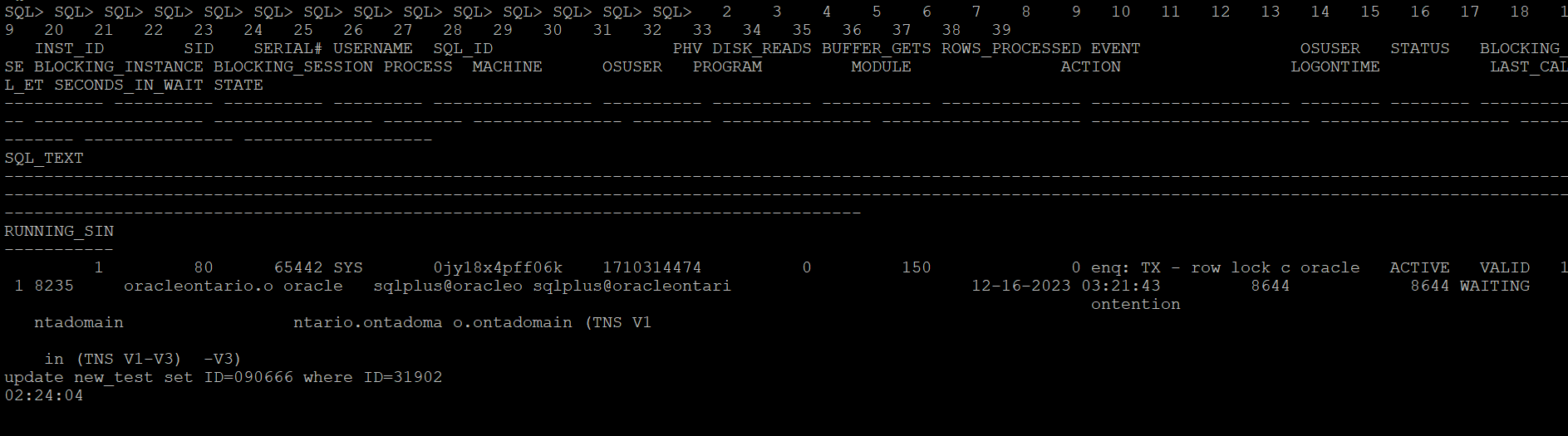
Lets query the database and see what is waiting on what ?? You will see SID 305 (session 2) is waiting for the txn level lock and waiting on event ‘enq: TX – row lock (HIGH priority)‘. BTW, this also a new event added into Oracle 23c for sessions waiting with HIGH priorities, other two are for LOW and MEDIUM priorities.

SQL>
SQL> select event#, name, WAIT_CLASS from v$event_name where name like '%TX - row%';

    EVENT# NAME                                                             WAIT_CLASS
---------- ---------------------------------------------------------------- ----------------------------------------------------------------
       340 enq: TX - row lock contention                                    Application
       341 enq: TX - row lock (HIGH priority)                               Application
       342 enq: TX - row lock (MEDIUM priority)                             Application
       343 enq: TX - row lock (LOW priority)                                Application

SQL>


-----------------------------------------------------------------
-- Contention details (What has blocked what ?)   
-----------------------------------------------------------------


SQL>

 INST_ID        SID    SERIAL# USERNAME                                                                                                                     SQL_ID PLAN_HASH_VALUE DISK_READS BUFFER_GETS ROWS_PROCESSED EVENT
---------- ---------- ---------- -------------------------------------------------------------------------------------------------------------------------------- ------------- --------------- ---------- ----------- -------------- ----------------------------------------------------------------
OSUSER                                                                                                                           STATUS   BLOCKING_SE BLOCKING_INSTANCE BLOCKING_SESSION PROCESS               MACHINE                                                          PROGRAM
-------------------------------------------------------------------------------------------------------------------------------- -------- ----------- ----------------- ---------------- ------------------------ ---------------------------------------------------------------- ------------------------------------------------------------------------------------
MODULE                                                           ACTION                                                           LOGONTIME           LAST_CALL_ET SECONDS_IN_WAIT STATE
---------------------------------------------------------------- ---------------------------------------------------------------- ------------------- ------------ --------------- -------------------
SQL_TEXT
----------------------------------------------------------------------------------------------------------------------------------------------------------------------------------------------------------------------------------------------------------------------------------------------------------------------------------------------------------------------------------------------------------------
RUNNING_SIN
-----------
         1        305      15926 SYS                                                                                                                          9jwbjqg195zdw      2635034114   0           6              0 enq: TX - row lock (HIGH priority)
oracle                                                                                                                           ACTIVE   VALID                   1        59 8808                     mississauga.candomain                                            sqlplus@mississauga.candomain (TNS V1-V3)
sqlplus@mississauga.candomain (TNS V1-V3)                                                                                         04-14-2023 22:46:35       12               13 WAITING
update dixit set id=00000000 where name='Fatdba'
00:00:12

The session 2 (SID 305) will wait for 15 seconds and database will automatically snipes session 1 (SID 59) due to LOW priority and UPDATE issued by Session 2 will persist, whereas session 1 (SID 59) and will throw “ORA-03135: connection lost contact”.

-- SESSION 1 with SID 59 
SQL>
SQL> select * from dixit;
select * from dixit
       *
ERROR at line 1:
ORA-03135: connection lost contact
Process ID: 8843
Session ID: 59 Serial number: 31129


-- SESSION 2 with SID 305 
SQL> update dixit set id=0 where name='Fatdba';

1 row updated.

SQL>    select * from dixit;

        ID NAME
---------- --------------------
         0 Fatdba
       101 Prashant

SQL>

Taking a moment to credit Kishy Kumar, Director of Development at Oracle Database and who also led the Priority Transactions project at Oracle, for giving me feedback on this post and helping me make necessary corrections. Link : https://www.linkedin.com/in/kishyk

Hope It Helped!
Prashant Dixit

Posted in Uncategorized | Tagged: , , , | 6 Comments »

Exploring new shiny Oracle 23 Developer Free Release …

Posted by FatDBA on April 8, 2023

Hi All,

Oracle on April 3, 2023 announced a free version of Oracle Database 23c (Release 23.0.0.0.0 – Developer-Release). Oracle Database 23c Free—Developer Release is available for download as a Docker Image, VirtualBox VM, or Linux RPM installation file, without requiring a user account or login.

Oracle 23c has a long list of new features, example Boolean datatype, No select from DUAL table just select it from the expression, lock free DMLs, joins in UPDATE & DELETE statements, 4096 columns in a table. Some of the development related additions i.e. drop table if exists, create table if not exists, Java script in the database (MLE), Multiple rows in a single insert command, store data as JSON and as relational both etc.

This long weekend gave me an opportunity to test the new Oracle 23c Developer release. This post is to explain the easy installation of the database on Oracle Linux 8 using RPM. You have to download Oracle 23c preinstall and core/main RPM file. Get it from the download link https://www.oracle.com/database/technologies/free-downloads.html

[root@mississauga files]#
[root@mississauga files]# ls
oracle-database-free-23c-1.0-1.el8.x86_64.rpm  oracle-database-preinstall-23c-1.0-0.5.el8.x86_64.rpm
[root@mississauga files]# yum install oracle-database-preinstall-23c-1.0-0.5.el8.x86_64.rpm
Last metadata expiration check: 0:03:51 ago on Sat 08 Apr 2023 01:17:02 PM EDT.
Dependencies resolved.
=============================================================================================================================================================
 Package                                          Architecture             Version                                 Repository                           Size
=============================================================================================================================================================
Installing:
 oracle-database-preinstall-23c                   x86_64                   1.0-0.5.el8                             @commandline                         30 k
Installing dependencies:
 compat-openssl10                                 x86_64                   1:1.0.2o-4.el8_6                        ol8_appstream                       1.1 M
 ksh                                              x86_64                   20120801-257.0.1.el8                    ol8_appstream                       929 k
 libnsl                                           x86_64                   2.28-211.0.1.el8                        ol8_baseos_latest                   105 k

Transaction Summary
=============================================================================================================================================================
Install  4 Packages

Total size: 2.2 M
Total download size: 2.1 M
Installed size: 6.3 M
Is this ok [y/N]: y
Downloading Packages:
(1/3): libnsl-2.28-211.0.1.el8.x86_64.rpm                                                                                    548 kB/s | 105 kB     00:00
(2/3): compat-openssl10-1.0.2o-4.el8_6.x86_64.rpm                                                                            4.5 MB/s | 1.1 MB     00:00
(3/3): ksh-20120801-257.0.1.el8.x86_64.rpm                                                                                   3.5 MB/s | 929 kB     00:00
-------------------------------------------------------------------------------------------------------------------------------------------------------------
Total                                                                                                                        7.9 MB/s | 2.1 MB     00:00
Oracle Linux 8 BaseOS Latest (x86_64)                                                                                        3.0 MB/s | 3.1 kB     00:00
Importing GPG key 0xAD986DA3:
 Userid     : "Oracle OSS group (Open Source Software group) <build@oss.oracle.com>"
 Fingerprint: 76FD 3DB1 3AB6 7410 B89D B10E 8256 2EA9 AD98 6DA3
 From       : /etc/pki/rpm-gpg/RPM-GPG-KEY-oracle
Is this ok [y/N]: y
Key imported successfully
Running transaction check
Transaction check succeeded.
Running transaction test
Transaction test succeeded.
Running transaction
  Preparing        :                                                                                                                                     1/1
  Installing       : ksh-20120801-257.0.1.el8.x86_64                                                                                                     1/4
  Running scriptlet: ksh-20120801-257.0.1.el8.x86_64                                                                                                     1/4
  Installing       : compat-openssl10-1:1.0.2o-4.el8_6.x86_64                                                                                            2/4
  Running scriptlet: compat-openssl10-1:1.0.2o-4.el8_6.x86_64                                                                                            2/4
  Installing       : libnsl-2.28-211.0.1.el8.x86_64                                                                                                      3/4
  Installing       : oracle-database-preinstall-23c-1.0-0.5.el8.x86_64                                                                                   4/4
  Running scriptlet: oracle-database-preinstall-23c-1.0-0.5.el8.x86_64                                                                                   4/4
  Verifying        : libnsl-2.28-211.0.1.el8.x86_64                                                                                                      1/4
  Verifying        : compat-openssl10-1:1.0.2o-4.el8_6.x86_64                                                                                            2/4
  Verifying        : ksh-20120801-257.0.1.el8.x86_64                                                                                                     3/4
  Verifying        : oracle-database-preinstall-23c-1.0-0.5.el8.x86_64                                                                                   4/4

Installed:
  compat-openssl10-1:1.0.2o-4.el8_6.x86_64 ksh-20120801-257.0.1.el8.x86_64 libnsl-2.28-211.0.1.el8.x86_64 oracle-database-preinstall-23c-1.0-0.5.el8.x86_64

Complete!


[root@mississauga files]#
[root@mississauga files]# dnf -y localinstall /root/Desktop/files/oracle-database-free-23c-1.0-1.el8.x86_64.rpm
Last metadata expiration check: 0:05:23 ago on Sat 08 Apr 2023 01:17:02 PM EDT.
Dependencies resolved.
=============================================================================================================================================================
 Package                                          Architecture                   Version                          Repository                            Size
=============================================================================================================================================================
Installing:
 oracle-database-free-23c                         x86_64                         1.0-1                            @commandline                         1.6 G

Transaction Summary
=============================================================================================================================================================
Install  1 Package

Total size: 1.6 G
Installed size: 5.2 G
Downloading Packages:
Running transaction check
Transaction check succeeded.
Running transaction test
Transaction test succeeded.
Running transaction
  Preparing        :                                                                                                                                     1/1
  Running scriptlet: oracle-database-free-23c-1.0-1.x86_64                                                                                               1/1
  Installing       : oracle-database-free-23c-1.0-1.x86_64                                                                                               1/1
  Running scriptlet: oracle-database-free-23c-1.0-1.x86_64                                                                                               1/1
[INFO] Executing post installation scripts...
[INFO] Oracle home installed successfully and ready to be configured.
To configure Oracle Database Free, optionally modify the parameters in '/etc/sysconfig/oracle-free-23c.conf' and then run '/etc/init.d/oracle-free-23c configure' as root.

  Verifying        : oracle-database-free-23c-1.0-1.x86_64                                                                                               1/1

Installed:
  oracle-database-free-23c-1.0-1.x86_64

Complete!
[root@mississauga files]#
[root@mississauga files]#


[root@mississauga ~]# cd /etc/init.d
[root@mississauga init.d]# ls
functions  oracle-database-preinstall-23c-firstboot  oracle-free-23c  README
[root@mississauga init.d]# /etc/init.d/oracle-free-23c configure
Specify a password to be used for database accounts. Oracle recommends that the password entered should be at least 8 characters in length, contain at least 1 uppercase character, 1 lower case character and 1 digit [0-9]. Note that the same password will be used for SYS, SYSTEM and PDBADMIN accounts:
Confirm the password:
Configuring Oracle Listener.

        Listener configuration succeeded.
Configuring Oracle Database FREE.
Enter SYS user password:                                                                                                                                    **********
Enter SYSTEM user password:
*******
Enter PDBADMIN User Password:
***********
Prepare for db operation
7% complete
Copying database files
29% complete
Creating and starting Oracle instance
30% complete
33% complete
36% complete
39% complete
43% complete
Completing Database Creation
47% complete
49% complete
50% complete
Creating Pluggable Databases
54% complete
71% complete
Executing Post Configuration Actions
93% complete
Running Custom Scripts
100% complete
Database creation complete. For details check the logfiles at:
 /opt/oracle/cfgtoollogs/dbca/FREE.
Database Information:
Global Database Name:FREE
System Identifier(SID):FREE
Look at the log file "/opt/oracle/cfgtoollogs/dbca/FREE/FREE.log" for further details.

Connect to Oracle Database using one of the connect strings:
     Pluggable database: mississauga.candomain/FREEPDB1
     Multitenant container database: mississauga.candomain

[oracle@mississauga ~]$ sqlplus / as sysdba
SQL*Plus: Release 23.0.0.0.0 - Developer-Release on Sat Apr 8 13:57:09 2023
Version 23.2.0.0.0
Copyright (c) 1982, 2023, Oracle.  All rights reserved.
Connected to:
Oracle Database 23c Free, Release 23.0.0.0.0 - Developer-Release
Version 23.2.0.0.0

SQL>

Done with the installation. Though there are multiple additions into Oracle 23c database, I would like to start with a quick one, insert multiple rows in a single INSERT command. If you use DBMSs such as MySQL or SQL Server, the syntax for inserting multiple rows into a table with a single statement is quite straightforward. Its now available in Oracle databases! 🙂

[oracle@mississauga ~]$ sqlplus / as sysdba
SQL*Plus: Release 23.0.0.0.0 - Developer-Release on Sat Apr 8 13:57:09 2023
Version 23.2.0.0.0
Copyright (c) 1982, 2023, Oracle.  All rights reserved.
Connected to:
Oracle Database 23c Free, Release 23.0.0.0.0 - Developer-Release
Version 23.2.0.0.0

SQL> select name, open_mode from v$database;

NAME      OPEN_MODE
--------- --------------------
FREE      READ WRITE

SQL> 
SQL> create table albumdetails (album_code number(10), albumrack_number number(10), albumreleaseyear number(20), albumtype varchar2(70));

Table created.

SQL>
SQL> insert into albumdetails (album_code, albumrack_number, albumreleaseyear, albumtype) values
('100','20','1999','Vinyl'),
('101','18','2008','cassattee'),
('102','01','1992','Vinyl'),
('103','05','1988','LPRecord'),
('104','05','2018','Vinyl');  

5 rows created.

Next I will be posting each of the new features and experiments that I will be doing on 23c.

Hope It Helped!
Prashant Dixit

Posted in Uncategorized | Tagged: , , | Leave a Comment »

Simplicity, Another great reason to move into Oracle Cloud Infrastructure …

Posted by FatDBA on March 31, 2023

Recently I was talking to someone who is using OCI Cloud, she asked us a question – If she can generate the AWR report on one of the database, but not sure if they have Oracle Tuning & Diagnostic (T&D pack) license ?

As they are running on 19c Oracle EE Extreme Performance bundle, there not only she has license for Diagnostics & Tuning Pack, ADG, RAC, In-Memory but other options too from the Oracle EE-HP (Image below).

By the way “Oracle EE Extreme Performance” will not give any boost to your Database’s performance by giving you more CPUs or Memory, but it has options that will help you to get the high performance.

There is a great post by Sinan (from datbase-heartbeat) about the same subject.

Hope It Helped!
Prashant Dixit

Posted in Uncategorized | Tagged: | Leave a Comment »

An Oracle Deadlock scenario and the importance of Event 10027 trace …

Posted by FatDBA on February 16, 2023

Hi Guys,

Recently someone asked me about Oracle debug 10027 trace event which we use in case of a deadlock scenario i.e. ORA-0060. Though the deadlock itself creates a trace file in DIAG directory, but 10027 trace event gives you a better control over the amount and type of DIAG information generated in response to the deadlock case. I mean the default trace file for deadlock (ora-60) contains cached cursors, a deadlock graph, process state info, current SQL Statements of the session involved and session wait history.
Event 10027 may be used to augment the trace information with a system state dump or a call stack in an attempt to find the root cause of the deadlocks. The minimum amount of trace information is written at level 1, at this level it will hardly contain deadlock graph and current AQL statements of the sessions involved.

In todays post I will try to simulate a deadlock scenario in one of my test box and will generate the 10027 trace with level 2 to get more information. Level 2 will give you cached cursors, process state info, session wait history for all sessions and the system state which is not possible in case of level 1. I am going to try with the Level 4 here as I want to get system state dump and don’t want to complicate this scenario.

I am going to create two tables – TableB is child table of TableA and some supporting objects to simulate the deadlock case.
Will try to simulate a deadlock scenario when insert/update/delete happens on TableB we need to sum the amount(amt) and then update it in TableA.total_amt column.

[oracle@oracleontario ~]$ sqlplus dixdroid/oracle90

SQL*Plus: Release 19.0.0.0.0 - Production on Thu Feb 16 03:58:12 2023
Version 19.15.0.0.0

Copyright (c) 1982, 2022, Oracle.  All rights reserved.

Last Successful login time: Thu Feb 16 2023 03:04:03 -05:00

Connected to:
Oracle Database 19c Enterprise Edition Release 19.0.0.0.0 - Production
Version 19.15.0.0.0

SQL> create table tableA (pk_id number primary key, total_amt number);

Table created.

SQL> create table tableB (pk_id number primary key, fk_id number references tableA(pk_id) not null, amt number);

Table created.

SQL>
SQL> CREATE OR REPLACE PACKAGE global_pkg
IS
fk_id tableA.pk_id%TYPE;
END global_pkg;  
/

Package created.

SQL>
SQL> CREATE OR REPLACE TRIGGER tableB_ROW_TRG
BEFORE INSERT OR UPDATE OR DELETE
ON tableB
FOR EACH ROW
BEGIN
IF INSERTING OR UPDATING
THEN
global_pkg.fk_id := :new.fk_id;
ELSE
global_pkg.fk_id := :old.fk_id;
END IF;
END tableB_ROW_TRG;
/

Trigger created.

SQL>
SQL>
SQL>
SQL> CREATE OR REPLACE TRIGGER tableB_ST_trg
AFTER INSERT OR UPDATE OR DELETE
ON tableB
BEGIN
IF UPDATING OR INSERTING
THEN
UPDATE tableA
SET total_amt =
(SELECT SUM (amt)
FROM tableB
WHERE fk_id = global_pkg.fk_id)
WHERE pk_id = global_pkg.fk_id;
ELSE
UPDATE tableA
SET total_amt =
(SELECT SUM (amt)
FROM tableB
WHERE fk_id = global_pkg.fk_id)
WHERE pk_id = global_pkg.fk_id;
END IF;
END tableB_ST_trg;

Trigger created.

SQL>
SQL>
SQL> insert into tableA values (1, 0);

1 row created.

SQL> insert into tableA values (2, 0);

1 row created.

SQL> insert into tableB values (123, 1, 100);

1 row created.

SQL> insert into tableB values (456,1, 200);

1 row created.

SQL> insert into tableB values (789, 1, 100);

1 row created.

SQL> insert into tableB values (1011, 2, 50);

1 row created.

SQL> insert into tableB values (1213,2, 150);

1 row created.

SQL> insert into tableB values (1415, 2, 50);

1 row created.

SQL> commit;

Commit complete.

SQL>

Lets query the table and see the record count and next will delete an entry from tableB and won’t commit. At the same time will check the locks — TM lock on tableA.

SQL>
SQL> select * from tableA;

     PK_ID  TOTAL_AMT
---------- ----------
         1        400
         2        250

SQL> delete tableB where pk_id = 1415;

1 row deleted.

SQL> SELECT sid,
(SELECT username
FROM v$session s
WHERE s.sid = v$lock.sid)
uname,
TYPE,
id1,
id2,
(SELECT object_name
FROM user_objects
WHERE object_id = v$lock.id1)
nm
FROM v$lock
WHERE sid IN (SELECT sid
FROM v$session
WHERE username IN (USER)); 


       SID UNAME                          TY        ID1        ID2 NM
---------- ------------------------------ -- ---------- ---------- ------------------------------
       440 DIXDROID                       AE        134          0
       440 DIXDROID                       TX     589853       3078
       440 DIXDROID                       TM      82284          0 TABLEB
       440 DIXDROID                       TM      82282          0 TABLEA


I will now connect to another session (sesion 2) and delete from tableB and that will induce a locking scenario in the database and session 2 will go into hung/waiting state.

---- from session 2:
SQL>
SQL>
SQL> delete tableB where pk_id = 1213;
.....
.........
............. <HUNG > <HUNG > <HUNG > <HUNG > <HUNG > 

Lets see more stats on the blocking session.

SQL>
SQL> SELECT (SELECT username
FROM v$session
WHERE sid = a.sid)
blocker,
a.sid,
' is blocking ',
(SELECT username
FROM v$session
WHERE sid = b.sid)
blockee,
b.sid
FROM v$lock a, v$lock b
WHERE a.block = 1 AND b.request > 0 AND a.id1 = b.id1 AND a.id2 = b.id2;  


BLOCKER                     SID 'ISBLOCKING'  BLOCKEE                               SID
-------------------- ---------- ------------- ------------------------------ ----------
DIXDROID                    440  is blocking  DIXDROID                              427

And as expected 440 SID is now blocking 427. Now lets go back to the original (session 1) and will try to delete from tableB again and this will snipe the session 2 which is still in hung/wait state and will throw a deadlock error (ORA-00060). Though we have already collected blocking information from v$lock + v$session but to get more clarify about blocking sessions, I will set the 10027 trace event with level 2.

This will increase our chance of finding the root cause of the deadlocks. If the setting shall persist across instance startups, you need to use the initialization parameter EVENT.

i.e. EVENT=”10027 trace name contex forever, level 2″ otherwise use ALTER SYSTEM version of it.

------------------------------------------------------------
-- Execute below statement in session1
------------------------------------------------------------
delete tableB where pk_id = 1213;


---------------------------------------------------------------------------------------
-- Oracle is throwing deadlock error as below in session2
---------------------------------------------------------------------------------------
SQL>
SQL> ALTER SYSTEM SET EVENTS '10027 trace name context forever, level 2';

System altered.

SQL> delete tableB where pk_id = 1213;
delete tableB where pk_id = 1213
       *
ERROR at line 1:
ORA-00060: deadlock detected while waiting for resource
ORA-06512: at "DIXDROID.TABLEB_ST_TRG", line 11
ORA-04088: error during execution of trigger 'DIXDROID.TABLEB_ST_TRG'

-- same captured in alert log too.
2023-02-16T04:02:57.648156-05:00
Errors in file /u01/app/oracle/diag/rdbms/dixitdb/dixitdb/trace/dixitdb_ora_29389.trc:
2023-02-16T04:03:00.019794-05:00
ORA-00060: Deadlock detected. See Note 60.1 at My Oracle Support for Troubleshooting ORA-60 Errors. More info in file /u01/app/oracle/diag/rdbms/dixitdb/dixitdb/trace/dixitdb_ora_29389.trc.

And we done, we were able to simulate the deadlock case in the database. Now lets dig into the trace file generated by the deadlock along with information flushed by 10027 trace event. It has all crucial information associated with the deadlock.

2023-02-16 04:13:34.115*:ksq.c@13192:ksqdld_hdr_dump():
DEADLOCK DETECTED ( ORA-00060 )
See Note 60.1 at My Oracle Support for Troubleshooting ORA-60 Errors

[Transaction Deadlock]


Deadlock graph:
                                          ------------Blocker(s)-----------  ------------Waiter(s)------------
Resource Name                             process session holds waits serial  process session holds waits serial
TX-00080009-00000C62-00000000-00000000         45     427     X        13193      24     440           X  22765
TX-0004001A-00000C1E-00000000-00000000         24     440     X        22765      45     427           X  13193


----- Information for waiting sessions -----
Session 427:
  sid: 427 ser: 13193 audsid: 3390369 user: 115/DIXDROID
    flags: (0x41) USR/- flags2: (0x40009) -/-/INC
    flags_idl: (0x1) status: BSY/-/-/- kill: -/-/-/-
  pid: 45 O/S info: user: oracle, term: UNKNOWN, ospid: 30174
    image: oracle@oracleontario.ontadomain (TNS V1-V3)
  client details:
    O/S info: user: oracle, term: pts/1, ospid: 30173
    machine: oracleontario.ontadomain program: sqlplus@oracleontario.ontadomain (TNS V1-V3)
    application name: SQL*Plus, hash value=3669949024
  current SQL:
  UPDATE TABLEA SET TOTAL_AMT = (SELECT SUM (AMT) FROM TABLEB WHERE FK_ID = :B1 ) WHERE PK_ID = :B1

Session 440:
  sid: 440 ser: 22765 audsid: 3380369 user: 115/DIXDROID
    flags: (0x41) USR/- flags2: (0x40009) -/-/INC
    flags_idl: (0x1) status: BSY/-/-/- kill: -/-/-/-
  pid: 24 O/S info: user: oracle, term: UNKNOWN, ospid: 29847
    image: oracle@oracleontario.ontadomain (TNS V1-V3)
  client details:
    O/S info: user: oracle, term: pts/2, ospid: 29846
    machine: oracleontario.ontadomain program: sqlplus@oracleontario.ontadomain (TNS V1-V3)
    application name: SQL*Plus, hash value=3669949024
  current SQL:
  delete tableB where pk_id = 1213

.....
.......


----- Current SQL Statement for this session (sql_id=duw5q5rpd5xvs) -----
UPDATE TABLEA SET TOTAL_AMT = (SELECT SUM (AMT) FROM TABLEB WHERE FK_ID = :B1 ) WHERE PK_ID = :B1
----- PL/SQL Call Stack -----
  object      line  object
  handle    number  name
0x8ed34c98        11  DIXDROID.TABLEB_ST_TRG
.......
.........


----- VKTM Time Drifts Circular Buffer -----
session 427: DID 0001-002D-000000D9     session 440: DID 0001-0018-0000001C
session 440: DID 0001-0018-0000001C     session 427: DID 0001-002D-000000D9

Rows waited on:
  Session 427: obj - rowid = 0001416A - AAAUFqAAHAAAMgvAAB
  (dictionary objn - 82282, file - 7, block - 51247, slot - 1)
  Session 440: obj - rowid = 0001416C - AAAUFsAAHAAAMg/AAE
  (dictionary objn - 82284, file - 7, block - 51263, slot - 4)
.....
.......


Current Wait Stack:
     0: waiting for 'enq: TX - row lock contention'
        name|mode=0x54580006, usn<<16 | slot=0x4001a, sequence=0xc1e
        wait_id=69 seq_num=70 snap_id=1
        wait times: snap=18.173838 sec, exc=18.173838 sec, total=18.173838 sec
        wait times: max=infinite, heur=18.173838 sec
        wait counts: calls=6 os=6
        in_wait=1 iflags=0x15a0
    There is at least one session blocking this session.
      Dumping 1 direct blocker(s):
        inst: 1, sid: 440, ser: 22765
      Dumping final blocker:
        inst: 1, sid: 440, ser: 22765
    There are 1 sessions blocked by this session.
    Dumping one waiter:
      inst: 1, sid: 440, ser: 22765
      wait event: 'enq: TX - row lock contention'
        p1: 'name|mode'=0x54580006
        p2: 'usn<<16 | slot'=0x80009
        p3: 'sequence'=0xc62
      row_wait_obj#: 82284, block#: 51263, row#: 4, file# 7
      min_blocked_time: 0 secs, waiter_cache_ver: 33942
    Wait State:
      fixed_waits=0 flags=0x22 boundary=(nil)/-1
    Session Wait History:
        elapsed time of 0.004677 sec since current wait
........
............


24: USER ospid 29847 sid 440 ser 22765, waiting for 'enq: TX - row lock contention'
          Cmd: DELETE
          Blocked by inst: 1, sid: 427, ser: 13193
          Final Blocker inst: 1, sid: 427, ser: 13193
.....
.............


45: USER ospid 30174 sid 427 ser 13193, waiting for 'enq: TX - row lock contention'
          Cmd: UPDATE
          Blocked by inst: 1, sid: 440, ser: 22765
          Final Blocker inst: 1, sid: 440, ser: 22765
.........
.............


 The history is displayed in reverse chronological order.

    sample interval: 1 sec, max history 120 sec
    ---------------------------------------------------
      [19 samples,                                         04:13:16 - 04:13:34]
        waited for 'enq: TX - row lock contention', seq_num: 70
          p1: 'name|mode'=0x54580006
          p2: 'usn<<16 | slot'=0x4001a
          p3: 'sequence'=0xc1e
      [14 samples,                                         04:13:01 - 04:13:15]
        idle wait at each sample
      [session created at: 04:13:01]
    ---------------------------------------------------
    Sampled Session History Summary:
      longest_non_idle_wait: 'enq: TX - row lock contention'
      [19 samples, 04:13:16 - 04:13:34]
    ---------------------------------------------------
.........
..........


      Virtual Thread:
      kgskvt: 0x9b0e7f10, sess: 0x9ccdd4b8, pdb: 0, sid: 427 ser: 13193
      vc: (nil), proc: 0x9db42028, idx: 427
      consumer group cur: OTHER_GROUPS (pdb 0) (upd? 0)
mapped: DEFAULT_CONSUMER_GROUP, orig:  (pdb 0)
      vt_state: 0x2, vt_flags: 0xE030, blkrun: 0, numa: 1
      inwait: 1, wait event: 307, posted_run: 0
      lastmodrngcnt: 0, lastmodrngcnt_loc: '(null)'
      lastmodrblcnt: 0, lastmodrblcnt_loc: '(null)'
      location where insched last set: kgskbwt
      location where insched last cleared: kgskbwt
      location where inwait last set: kgskbwt
      location where inwait last cleared: NULL
      is_assigned: 1, in_scheduler: 0, insched: 0
      vt_active: 0 (pending: 1)
      vt_pq_active: 0, dop: 0, pq_servers (cur: 0 cg: 0)
      ps_allocs: 0, pxstmts (act: 0, done: 0 cg: 0)
      used quanta (usecs):
      stmt: 57272, accum: 0, mapped: 0, tot: 57272
      exec start consumed time lapse: 164377 usec
      exec start elapsed time lapse: 18179246 usec
      idle time: 0 ms, active time: 57272 (cg: 57272) usec
      last updnumps: 0 usec, active time (pq: 0 ps: 0) ms
      cpu yields:       stmt: 0, accum: 0, mapped: 0, tot: 0
      cpu waits:       stmt: 0, accum: 0, mapped: 0, tot: 0
      cpu wait time (usec):       stmt: 0, accum: 0, mapped: 0, tot: 0
      ASL queued time outs: 0, time: 0 (cur 0, cg 0)
      PQQ queued time outs: 0, time: 0 (cur 0, cg 0)
      Queue timeout violation: 0
      calls aborted: 0, num est exec limit hit: 0
      KTU Session Commit Cache Dump for IDLs:
      KTU Session Commit Cache Dump for Non-IDLs:
      ----------------------------------------
........
.............

Hope It Helped!
Prashant Dixit

Posted in Uncategorized | Tagged: , , , | 2 Comments »