


Checking MySQL replication is one of those things DBAs do on autopilot. Log in, open the MySQL client, run SHOW SLAVE STATUS\G or SHOW REPLICA STATUS\G, scroll, scan for Yes, check lag, repeat. It works, but it is noisy, raw, and easy to misread when you are tired or troubleshooting multiple servers.
In some free time, I played around with shell scripting to clean this up. The goal was not to replace MySQL, but to wrap the same information into something that answers the real question faster: is replication healthy or not, and how bad is it if it is not.
The script runs with strict shell settings so failures are never hidden. It connects using a MySQL login path first and falls back to a secure defaults file, which keeps credentials out of the script. If MySQL cannot be reached or authentication fails, the script stops immediately and shows the real error instead of pretending replication is broken.
Because environments are rarely consistent, the script automatically detects whether the server supports SHOW REPLICA STATUS or still uses SHOW SLAVE STATUS. It figures this out by checking for known fields and then sticks to the correct command, which makes it usable across old and new MySQL versions without edits.
Once the raw replication output is captured, the script parses individual fields directly from the \G output using awk. It handles both old and new field names, so Source_Host and Master_Host are treated the same. The same approach is used for thread states, binlog positions, relay logs, delay, and error fields. If replication is not configured and MySQL returns an empty result, the script fails clearly instead of silently succeeding.
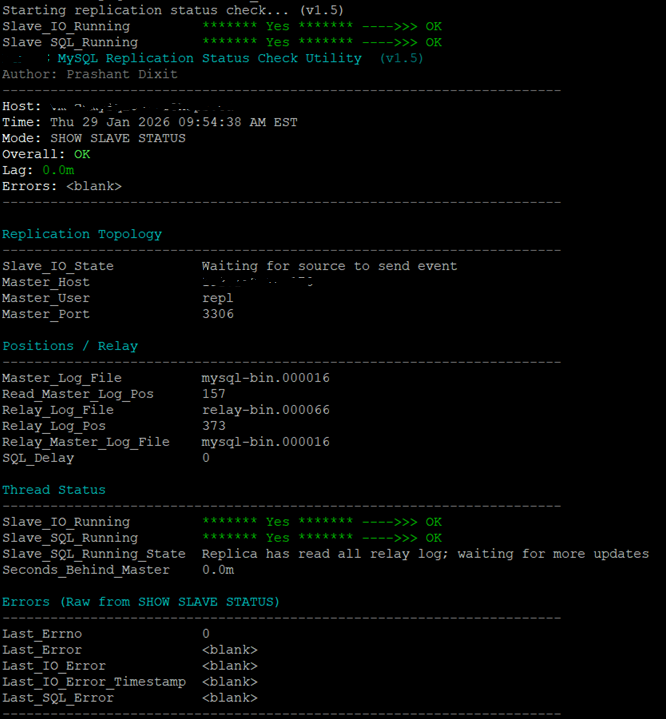
From there, it starts behaving more like a DBA than a SQL dump. IO and SQL threads are evaluated and clearly marked as OK, PROBLEM, or UNKNOWN. Replication lag is converted from seconds into minutes and evaluated against simple thresholds so you immediately know whether it is harmless or serious. If any SQL or IO errors exist, replication is considered critical even if threads appear to be running.
One thing I was very deliberate about is that the script always prints the full report, even when replication is stopped or broken. When things go wrong, you still see topology details, binlog and relay positions, thread states, and error messages in one place. Nothing is hidden when you need it the most.
The output is structured like a quick operational report, with hostname, timestamp, replication mode, overall health, lag, and error presence shown at the top. Color highlighting is used only in interactive sessions, so the script remains safe for logging and automation.
Finally, the script exits with meaningful return codes. A clean replication state exits successfully, warning conditions return a different code, and critical failures return a hard error. This makes it easy to plug into cron jobs or monitoring without parsing text output.
This started as a small free-time experiment, but it turned into something I actually use. Shell scripting may not be glamorous, but for DBAs it is one of the fastest ways to remove friction from daily work. If you find yourself running the same replication commands again and again, that is usually a sign that a small script can make life easier.
#!/usr/bin/env bash
set -euo pipefail

# -------------------------------------------------------------------
# Author : Prashant Dixit
# Version: 1.5 (always print full report + cleaner header formatting)
# Notes  : Shows full sections even when replication is stopped / broken.
# -------------------------------------------------------------------

MYSQL_BIN="${MYSQL_BIN:-/usr/bin/mysql}"

MYSQL_LOGIN_PATH="${MYSQL_LOGIN_PATH:-testadmin_local}"

MYSQL_CNF="${MYSQL_CNF:-/root/.my-shutdown.cnf}"

if [[ -t 1 ]]; then
  RED=$'\033[0;31m'
  GREEN=$'\033[0;32m'
  YELLOW=$'\033[0;33m'
  BLUE=$'\033[0;34m'
  CYAN=$'\033[0;36m'
  BOLD=$'\033[1m'
  DIM=$'\033[2m'
  RESET=$'\033[0m'
else
  RED=""; GREEN=""; YELLOW=""; BLUE=""; CYAN=""; BOLD=""; DIM=""; RESET=""
fi

hr()  { printf "%s\n" "${DIM}----------------------------------------------------------------------${RESET}"; }
hdr() { printf "%s\n" "${BOLD}${CYAN}$*${RESET}"; }
die() { echo "${RED}ERROR:${RESET} $*"; exit 2; }

mysql_run() {
  # Try login-path first, fallback to defaults-file
  local q="$1" out rc
  out="$("$MYSQL_BIN" --login-path="$MYSQL_LOGIN_PATH" -e "$q" 2>&1)" && { echo "$out"; return 0; }
  rc=$?

  if [[ -r "$MYSQL_CNF" ]]; then
    out="$("$MYSQL_BIN" --defaults-file="$MYSQL_CNF" -e "$q" 2>&1)" && { echo "$out"; return 0; }
    rc=$?
    echo "$out"
    return $rc
  fi

  echo "$out"
  return $rc
}

detect_status_cmd() {
  # If SHOW REPLICA STATUS works, use it; else fallback to SLAVE
  if mysql_run "SHOW REPLICA STATUS\\G" | grep -qE '^[[:space:]]*(Replica_IO_State|Source_Host):'; then
    echo "SHOW REPLICA STATUS\\G"
  else
    echo "SHOW SLAVE STATUS\\G"
  fi
}

STATUS_CMD="$(detect_status_cmd)"


STATUS_RAW="$(mysql_run "$STATUS_CMD" 2>&1 || true)"

if echo "$STATUS_RAW" | grep -qiE "^(ERROR|mysql:)|Access denied|unknown option|Can't connect|Can't connect to local MySQL server|ERROR [0-9]+"; then
  echo "$STATUS_RAW"
  exit 2
fi


if [[ -z "${STATUS_RAW//[[:space:]]/}" ]]; then
  die "No replica/slave status returned. Is this server configured as a replica?"
fi

get_field() {
  local key="$1"
  echo "$STATUS_RAW" |
    awk -F': ' -v k="$key" '
      {
        gsub(/^[ \t]+|[ \t]+$/, "", $1)
        if ($1 == k) {print $2; found=1; exit}
      }
      END {if (!found) print ""}'
}

Slave_IO_State="$(get_field "Replica_IO_State")"; [[ -n "$Slave_IO_State" ]] || Slave_IO_State="$(get_field "Slave_IO_State")"

Master_Host="$(get_field "Source_Host")"; [[ -n "$Master_Host" ]] || Master_Host="$(get_field "Master_Host")"
Master_User="$(get_field "Source_User")"; [[ -n "$Master_User" ]] || Master_User="$(get_field "Master_User")"
Master_Port="$(get_field "Source_Port")"; [[ -n "$Master_Port" ]] || Master_Port="$(get_field "Master_Port")"

Master_Log_File="$(get_field "Source_Log_File")"; [[ -n "$Master_Log_File" ]] || Master_Log_File="$(get_field "Master_Log_File")"
Read_Master_Log_Pos="$(get_field "Read_Source_Log_Pos")"; [[ -n "$Read_Master_Log_Pos" ]] || Read_Master_Log_Pos="$(get_field "Read_Master_Log_Pos")"

Relay_Log_File="$(get_field "Relay_Log_File")"
Relay_Log_Pos="$(get_field "Relay_Log_Pos")"

Relay_Master_Log_File="$(get_field "Relay_Source_Log_File")"
[[ -n "$Relay_Master_Log_File" ]] || Relay_Master_Log_File="$(get_field "Relay_Master_Log_File")"

SQL_Delay="$(get_field "SQL_Delay")"

Slave_IO_Running="$(get_field "Replica_IO_Running")"; [[ -n "$Slave_IO_Running" ]] || Slave_IO_Running="$(get_field "Slave_IO_Running")"
Slave_SQL_Running="$(get_field "Replica_SQL_Running")"; [[ -n "$Slave_SQL_Running" ]] || Slave_SQL_Running="$(get_field "Slave_SQL_Running")"

Slave_SQL_Running_State="$(get_field "Replica_SQL_Running_State")"
[[ -n "$Slave_SQL_Running_State" ]] || Slave_SQL_Running_State="$(get_field "Slave_SQL_Running_State")"

Seconds_Behind_Master="$(get_field "Seconds_Behind_Source")"
[[ -n "$Seconds_Behind_Master" ]] || Seconds_Behind_Master="$(get_field "Seconds_Behind_Master")"

Last_Errno="$(get_field "Last_Errno")"
Last_Error="$(get_field "Last_Error")"

Last_IO_Error="$(get_field "Last_IO_Error")"
Last_IO_Error_Timestamp="$(get_field "Last_IO_Error_Timestamp")"

Last_SQL_Error="$(get_field "Last_SQL_Error")"

fmt_kv() {
  local k="$1" v="${2:-}"
  [[ -n "${v// /}" ]] || v="<blank>"
  printf "%-24s %s\n" "$k" "$v"
}

emph_status() {
  local label="$1"
  local value="${2:-}"
  local norm="${value,,}"

  [[ -n "${value// /}" ]] || value="<blank>"

  if [[ "$norm" == "yes" ]]; then
    printf "%-24s %s\n" "$label" "${GREEN}******* ${value} ******* ---->>> OK${RESET}"
    return 0
  elif [[ "$norm" == "no" ]]; then
    printf "%-24s %s\n" "$label" "${RED}******* ${value} ******* ---->>> PROBLEM${RESET}"
    return 2
  else
    printf "%-24s %s\n" "$label" "${YELLOW}******* ${value} ******* ---->>> UNKNOWN${RESET}"
    return 1
  fi
}

sec_to_min() {
  local s="${1:-}"
  [[ "$s" =~ ^[0-9]+$ ]] || { echo "<blank>"; return; }

  if (( s < 600 )); then
    awk -v sec="$s" 'BEGIN { printf "%.1fm", sec/60 }'
  else
    awk -v sec="$s" 'BEGIN { printf "%dm", int(sec/60) }'
  fi
}


overall="OK"
overall_color="$GREEN"

io_rc=0; sql_rc=0
emph_status "Slave_IO_Running" "${Slave_IO_Running:-}"; io_rc=$?
emph_status "Slave_SQL_Running" "${Slave_SQL_Running:-}"; sql_rc=$?

if [[ $io_rc -eq 2 || $sql_rc -eq 2 ]]; then
  overall="CRITICAL"; overall_color="$RED"
elif [[ $io_rc -eq 1 || $sql_rc -eq 1 ]]; then
  overall="WARNING"; overall_color="$YELLOW"
fi

lag_hint="<blank>"
if [[ -n "${Seconds_Behind_Master// /}" ]] && [[ "${Seconds_Behind_Master}" =~ ^[0-9]+$ ]]; then
  lag_min="$(sec_to_min "$Seconds_Behind_Master")"
  if (( Seconds_Behind_Master == 0 )); then
    lag_hint="${GREEN}${lag_min}${RESET}"
  elif (( Seconds_Behind_Master <= 30 )); then
    lag_hint="${YELLOW}${lag_min}${RESET}"
    [[ "$overall" == "OK" ]] && overall="WARNING" && overall_color="$YELLOW"
  else
    lag_hint="${RED}${lag_min}${RESET}"
    overall="CRITICAL"; overall_color="$RED"
  fi
fi

err_hint="<blank>"
if [[ -n "${Last_SQL_Error// /}${Last_IO_Error// /}${Last_Error// /}" ]]; then
  err_hint="${RED}Errors present${RESET}"
  overall="CRITICAL"; overall_color="$RED"
fi

clear 2>/dev/null || true

hdr "MySQL Replication Status Check Utility  ${DIM}(v1.5)${RESET}"
echo "${DIM}Author: Prashant Dixit${RESET}"
hr
printf "%s %s\n" "${BOLD}Host:${RESET}" "$(hostname -f)"
printf "%s %s\n" "${BOLD}Time:${RESET}" "$(date)"
printf "%s %s\n" "${BOLD}Mode:${RESET}" "${STATUS_CMD%%\\G}"
printf "%s %s  %s  %s\n" "${BOLD}Overall:${RESET}" "${overall_color}${BOLD}${overall}${RESET}" "${BOLD}Lag:${RESET} ${lag_hint}" "${err_hint}"
hr
echo

hdr "Replication Topology"
hr
fmt_kv "Slave_IO_State" "${Slave_IO_State:-}"
fmt_kv "Master_Host" "${Master_Host:-}"
fmt_kv "Master_User" "${Master_User:-}"
fmt_kv "Master_Port" "${Master_Port:-}"
echo

hdr "Positions / Relay"
hr
fmt_kv "Master_Log_File" "${Master_Log_File:-}"
fmt_kv "Read_Master_Log_Pos" "${Read_Master_Log_Pos:-}"
fmt_kv "Relay_Log_File" "${Relay_Log_File:-}"
fmt_kv "Relay_Log_Pos" "${Relay_Log_Pos:-}"
fmt_kv "Relay_Master_Log_File" "${Relay_Master_Log_File:-}"
fmt_kv "SQL_Delay" "${SQL_Delay:-}"
echo

hdr "Thread Status"
hr
emph_status "Slave_IO_Running" "${Slave_IO_Running:-}"
emph_status "Slave_SQL_Running" "${Slave_SQL_Running:-}"
fmt_kv "Slave_SQL_Running_State" "${Slave_SQL_Running_State:-}"
fmt_kv "Seconds_Behind_Master" "$(sec_to_min "${Seconds_Behind_Master:-}")"
echo

hdr "Errors"
hr
fmt_kv "Last_Errno" "${Last_Errno:-}"
fmt_kv "Last_Error" "${Last_Error:-}"
fmt_kv "Last_IO_Error" "${Last_IO_Error:-}"
fmt_kv "Last_IO_Error_Timestamp" "${Last_IO_Error_Timestamp:-}"
fmt_kv "Last_SQL_Error" "${Last_SQL_Error:-}"
hr
echo

if [[ "$overall" == "OK" ]]; then
  exit 0
elif [[ "$overall" == "WARNING" ]]; then
  exit 1
else
  exit 2
fi
Hope It Helped!
Prashant Dixit
 Tales From A Lazy Fat DBA